
Everything you should know about commercial laminate flooring in Ottawa
March 30, 2022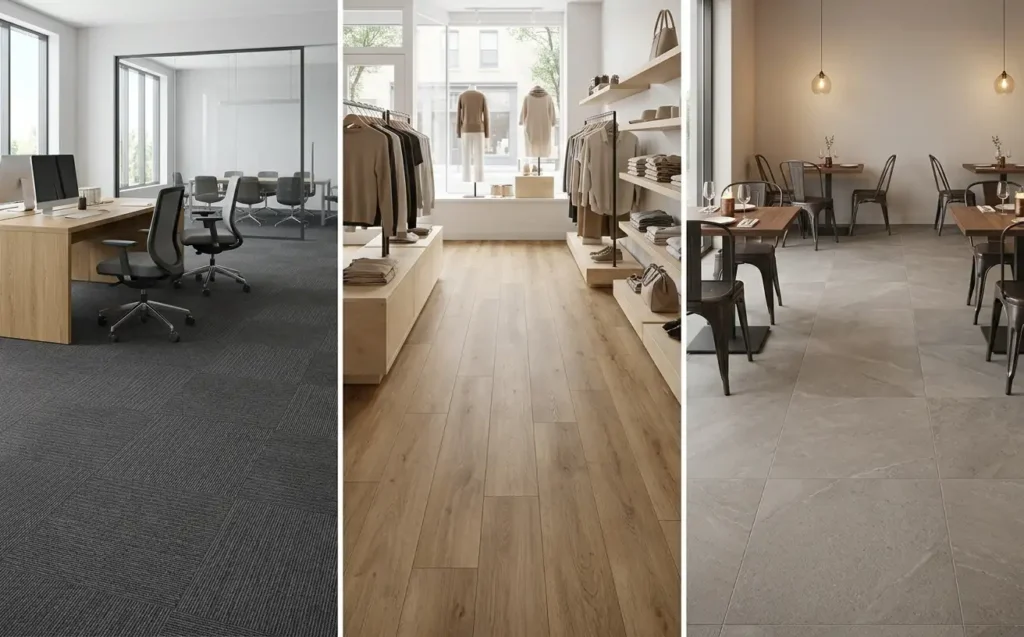
A commercial floor has a job that a residential floor doesn’t. It has to survive traffic volumes that would destroy a home floor in a year, it has to meet code, it has to be repairable without shutting the business, and it has to do all of that while looking like somewhere people want to spend money or spend their working day.
That combination narrows the field quickly, and it means the reasoning behind commercial flooring is genuinely different from residential reasoning. The material that’s perfect in a living room can be a liability in a lobby, and the one that would look institutional at home is often exactly right in an office.
What Makes Commercial Different
Four factors change the calculation, and each one rules out materials that would be fine in a house.
Traffic volume is the obvious one, since a busy retail entrance takes more footfall in a week than a family home takes in a year, concentrated in the same few square metres. Downtime is the expensive one, because every day your floor is out of service is a day the business isn’t operating normally, which pushes you towards materials that install quickly and formats that can be repaired in sections rather than replaced wholesale.
Code and liability matter more than they do at home. Slip resistance isn’t a preference, it’s a duty of care, and fire ratings and accessibility requirements govern transitions and thresholds.
And maintenance is a running cost rather than an occasional chore. A floor needing specialist cleaning every month costs real money across a decade, and that belongs in the decision rather than in an afterthought.
Grading: The Spec That Actually Matters
The most useful thing to understand about commercial flooring is that products are graded, and residential grades won’t survive.
Laminate flooring is rated on an AC scale, where AC3 handles normal residential use, AC4 covers heavy residential and light commercial, and AC5 is built for genuine commercial traffic. Putting an AC3 board in a retail unit isn’t a saving, it’s a scheduled replacement.
Vinyl is graded by wear layer thickness, and commercial-grade wear layers are substantially thicker than residential ones. The wear layer is the only thing standing between the traffic and the printed design beneath it, and when it goes, the floor goes. Tile carries a PEI rating for surface abrasion, with commercial floors needing the higher classes, and carpet is graded for commercial use as well, with a construction and density a residential product doesn’t have.
The pattern is consistent. Every material has a commercial specification, it costs more than the residential version, and buying down is the most expensive decision available to you.
Choosing by Space
Three environments cover most of what Ottawa businesses need, and each one asks for something different.
Offices
Offices are about durability, sound, and the impression the space makes.
Commercial carpet flooring is the traditional answer and remains a strong one. It absorbs sound, which matters enormously in open-plan spaces where acoustics are usually the biggest complaint, and modern commercial products are far tougher than the office carpet of twenty years ago.
Carpet tiles deserve a closer look than they usually get. Because the floor is laid in modules, a damaged or stained area can be lifted and swapped without touching the rest of the room, which is genuinely useful in a space where someone will eventually spill coffee near reception.
Luxury vinyl plank has taken enormous ground in offices, and for good reason. It looks like wood, costs far less than wood, handles chair casters without complaint, and wipes clean. Where you want warmth and professionalism without a hardwood budget, vinyl flooring is often the right answer. Commercial laminate is the budget-conscious option and performs well provided the grade is right, and our guide to commercial laminate flooring covers what maintenance it actually needs.
Retail
Retail is where the floor does marketing work as well as structural work.
Your floor sets the tone of the store before a customer looks at a single product, and it directs how they move through the space. Different materials in different zones define departments without a wall, and a change in colour or direction guides traffic more effectively than signage does. Our guide to a guide to flooring room transitions contrasting tones covers how to pull this off without awkward seams.
Durability requirements are severe near entrances. An Ottawa retail entrance in winter takes salt, slush, and grit continuously for months, which is one of the harshest environments any floor faces. Porcelain handles it better than anything else, absorbing almost no water while its hardness shrugs off grit, and our ottawa tiles range includes the porcelain and Olympia lines that suit high-traffic entrances.
Beyond the entrance, luxury vinyl gives you the appearance flexibility retail wants without tile’s cost or coldness, and it’s softer for staff who stand on it all day. Where a premium brand wants genuine hardwood, it can be done, but go in clear-eyed: hardwood flooring in retail will show wear and will need refinishing on a cycle. For some brands that patina is exactly the point, and for others it’s a maintenance problem. Engineered hardwood is often the better commercial route because it tolerates humidity swings and heavy traffic better than solid wood.
Restaurants
Restaurants are the hardest flooring environment there is, and front of house and back of house are two completely different problems.
Back of house isn’t a design question at all. Kitchens involve grease, water, dropped equipment, and staff moving quickly, so slip resistance is a legal and moral requirement rather than a preference. Any floor going into a commercial kitchen has to be rated for it, and textured tile is water and slip-resistant by design, which is why it dominates.
Front of house is a design question with constraints. Spills are constant, chairs get dragged across the floor thousands of times a week, and traffic funnels through the same paths between tables in shoes, which is harder on a floor than bare feet ever are. Waterproof vinyl flooring is often the right answer where spills are inevitable.
Porcelain tile is the workhorse, because it survives all of that and cleans easily. Commercial-grade luxury vinyl is the alternative where you want warmth and a quieter room, and it’s softer for staff on their feet for eight hours. Hardwood in a dining room is achievable and it looks superb, but it needs floor refinishing on a cycle, and refinishing means closing.
Installation and Downtime
Here’s the question residential customers never have to ask: how long is the floor out of service?
Faster installation costs less in lost trading, and that changes which methods make sense. Floating floors go down quickly, glue-down needs cure time, and tile needs setting, grouting, and curing, which is why it’s usually the longest install of the three.
Phasing is worth planning properly. Many commercial floors can be done in sections, keeping part of the space operating while the rest is worked on, and scheduling around trading hours or a quiet season is normal practice. Professional flooring installation that plans around your operating hours is worth more than a slightly cheaper quote that shuts you down for a week, and our pre-installation checklist covers the prep that keeps projects on schedule.
Subfloor preparation is the same discipline as residential but at larger scale, and it’s where most commercial flooring failures originate. Moisture testing on concrete is essential, and levelling matters more over big open spans, not less. Our full floor installation service covers each of these stages as a matter of course.
The Running Cost You’ll Live With
Maintenance is a real number across a decade, and it belongs in the comparison alongside the purchase price.
Tile is the cheapest to maintain: sweep, mop, attend to the grout periodically, and it lasts decades. Vinyl and laminate are nearly as easy, needing regular cleaning, sensible products, and no steam mops. Our guide to winter floor maintenance covers the seasonal routines that keep Ottawa commercial floors looking right through the salt-and-slush months.
Carpet is the most demanding, needing regular vacuuming, periodic deep cleaning, and prompt stain response. Carpet tiles mitigate this by making replacement modular, but the maintenance cycle is still real.
Hardwood needs the most attention and rewards it the most, because refinishing gives it a life no other commercial floor has. Ongoing hardwood floor care determines whether that refinish is due in eight years or fifteen.
Tell Us Your Traffic and Your Trading Hours
Commercial flooring decisions turn on details that never show up in a catalogue: your actual traffic volumes, your operating hours, your subfloor, your code requirements, and how much downtime you can genuinely absorb.
We carry the full range of commercial-grade materials, from tile and luxury vinyl through to commercial carpet and hardwood, and we install and refinish all of them. Visit our flooring showroom on Colonnade Road to see commercial-grade products alongside residential so you can understand the difference, browse our room scenes gallery, and review our our work portfolio for completed projects.
Planning a fit-out or a refresh? Contact our commercial flooring team or call 613-274-7977 to arrange a free on-site estimate for your space.
