

Pet-Friendly Flooring: Best Options for Ottawa Families with Dogs and Cats
April 24, 2026
What to Expect During Professional Flooring Installation in Ottawa
May 8, 2026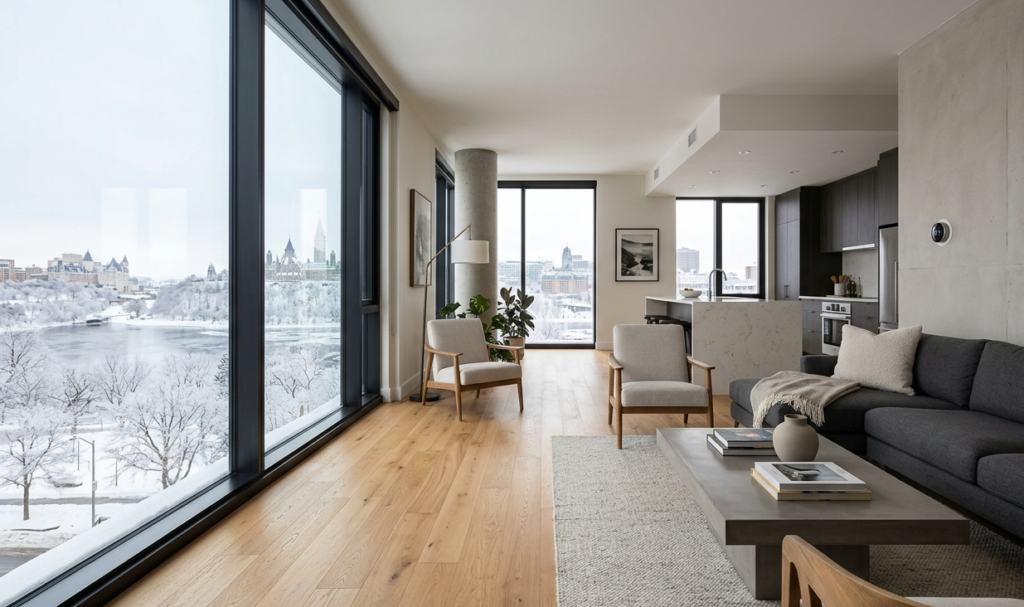
Ottawa’s condo market continues to grow, and condo flooring presents unique challenges that differ significantly from traditional homes. Concrete subfloors, noise reduction requirements, building regulations, and radiant heating systems all influence which flooring solutions work best.
The Concrete Subfloor Challenge
Unlike houses with plywood subfloors, most Ottawa condos have concrete slab construction. This affects flooring selection in several important ways:
- Moisture migration: Concrete is porous and can transmit moisture vapour from below, even on upper floors. A moisture barrier or vapour retarder is essential for most flooring installations over concrete. Understanding how moisture interacts with different materials is critical, and our guide on hardwood moisture problems explains why wood-based floors are especially vulnerable.
- Flatness requirements: Concrete slabs aren’t always perfectly flat. Dips and humps need to be addressed before installation—self-levelling compound is a common solution. Professional flooring installation includes thorough subfloor assessment and preparation to ensure your new floors sit perfectly level.
- Installation limitations: Nail-down installation (the standard method for solid hardwood in houses) isn’t possible on concrete. You’re limited to floating, glue-down, or click-lock methods.
- Cold surface: Concrete is inherently cold, making underfoot comfort and radiant heat compatibility important considerations.
Best Condo Flooring Options
1. Engineered Hardwood — The Premium Choice
Engineered hardwood flooring is the ideal real-wood option for condos. Its dimensional stability handles concrete’s moisture characteristics far better than solid hardwood flooring, and it can be installed as a floating floor or glued directly to concrete. For a detailed breakdown of how these two options compare, our guide on the difference between solid wood and engineered wood covers construction, performance, and refinishing potential.
- Floating installation with quality underlayment addresses both sound transmission and moisture concerns
- Glue-down installation provides the most solid feel and best sound performance
- Compatible with most radiant heating systems (check manufacturer specifications for maximum surface temperature, typically 27°C)
- Available in wide planks for a contemporary aesthetic that suits modern condo design
2. Luxury Vinyl Plank (LVP) — The Practical Choice
Vinyl flooring excels in condo applications thanks to its waterproof core, dimensional stability over concrete, and excellent sound dampening, especially with attached underlayment. Many newer Ottawa condos specify LVP as the standard flooring upgrade. If you are debating between LVP and real wood, our comparison of luxury vinyl plank vs hardwood breaks down cost, durability, and performance differences.
- Zero moisture sensitivity—perfect over concrete at any level
- Click-lock floating installation is fast and condo-friendly
- Compatible with radiant heating (SPC core preferred for heat transfer)
- Excellent impact sound reduction with quality underlayment
3. Porcelain Tile
Ottawa tiles in porcelain are the ultimate condo flooring for moisture-prone areas like kitchens, bathrooms, and entryways. Tile is also an excellent conductor of radiant heat, warming quickly and distributing heat evenly.
- Ideal for condos with in-floor radiant heating—best heat transfer of any flooring type
- Zero moisture sensitivity
- Consider wood-look porcelain for continuity with other rooms
Other Options Worth Considering
Laminate flooring can work well in condos, particularly waterproof options with click-lock installation designed for concrete subfloors. It offers a budget-friendly alternative to engineered hardwood while delivering convincing wood-look aesthetics. Cork flooring is another condo-friendly option that provides natural sound dampening and warmth underfoot, though it is less suitable over radiant heat systems. For bedrooms where softness and sound absorption are priorities, carpet flooring remains a comfortable and affordable choice that easily meets condo sound rating requirements.
Condo Sound Ratings: Understanding STC and IIC
Most Ottawa condo buildings require minimum sound ratings for flooring installations. Two ratings matter:
- STC (Sound Transmission Class): Measures airborne sound (voices, music). Most buildings require STC 50–55 or higher.
- IIC (Impact Insulation Class): Measures impact sound (footsteps, dropped objects). Most buildings require IIC 55–65 or higher.
Quality underlayment is critical for meeting these requirements. Cork and rubber underlayments typically deliver the best sound performance. Always verify your building’s specific requirements before purchasing flooring.
Radiant Heat Compatibility
Radiant floor heating is increasingly popular in Ottawa condos, and your flooring choice directly affects its efficiency:
- Best heat transfer: Porcelain/ceramic tile, then engineered hardwood (glued down), then LVP
- Important limitations: Most flooring manufacturers limit surface temperature to 27–29°C. Exceeding this voids warranties.
- Avoid over concrete with radiant heat: Thick cork or foam underlayments—they insulate against the heat you’re trying to transfer
Proper floor care and maintenance also plays a role in radiant heat performance. Keeping your floors clean and in good condition ensures consistent heat distribution and protects your investment over time.
Visit our flooring showroom on Colonnade Road to see engineered hardwood, LVP, and tile options suited for condo applications. Browse our room scenes to visualize how different materials look in modern living spaces, and check out our work to see condo flooring projects we have completed across Ottawa.
Ready to get started? Contact us or call Continental Flooring at 613-274-7977 to schedule your free consultation, or visit our showroom to explore your options in person.
