
Glass Railings for Modern Ottawa Staircases: Design and Installation
July 14, 2026
Iron Railings for Ottawa Staircases: Classic and Modern Styles
August 10, 2026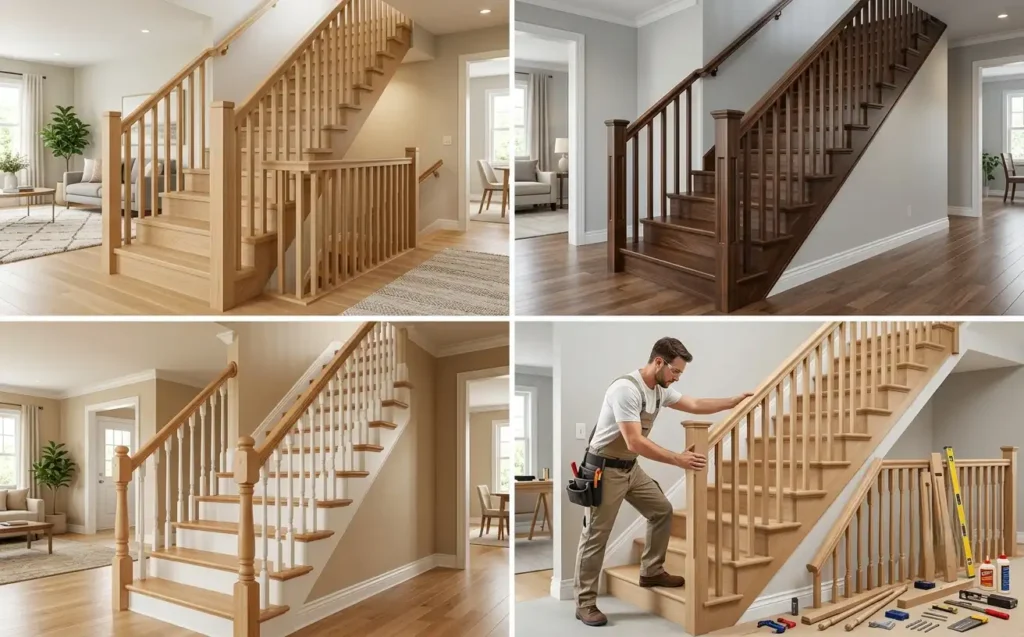
The railing does more work than any other part of your staircase. It’s the piece your hand touches every day, it carries the entire safety burden, and visually it’s what people actually see, because a row of balusters occupies far more of the sightline than the treads ever do.
Wood railings remain the most common choice in Ottawa homes, and they’ve held that position for a reason. Wood is warm to grip, it can be shaped into almost any profile, it takes stain to match anything else in the house, and it can be repaired rather than replaced. But “wood railing” covers an enormous range, from a heavy colonial newel post to a slim contemporary cap rail, and the differences are worth understanding before you commit.
The Four Parts You’re Choosing
The vocabulary trips people up, so it helps to name the pieces.
The handrail is the top member your hand slides along. The balusters, sometimes called spindles, are the vertical members filling the space beneath it. The newel post is the heavy anchor post at the bottom of a run and at each turn or landing. And the shoe rail, where present, is the horizontal member the balusters sit into at the base.
Almost every design decision comes down to how these four are proportioned against one another. Heavy newels with turned balusters read traditional. Slim newels with square balusters read contemporary. The handrail profile ties it together.
Choosing Your Species
Species affects colour, grain, hardness, and how the wood takes stain, and it affects price considerably. We work in oak, maple, cherry, and ash, which covers most of what an Ottawa home will want.
Oak
Oak is the workhorse and the safe choice. Red oak has open, pronounced grain that takes stain beautifully and hides small dings well. White oak is tighter, with subtler figure and naturally warm undertones, and it’s become the default in contemporary work. Both are hard enough to withstand decades of hands and furniture.
If you’re already looking at oak stairs for the treads, carrying the same species into the railing is the simplest way to guarantee the stain matches.
Maple
Maple stairs and maple railings suit you if you want something quieter. The grain is fine and uniform, producing a clean, modern surface. The caution is stain: maple is dense and closed-grained, so dark stains can go blotchy without careful preparation. In a natural or lightly toned finish it’s superb.
Cherry
Cherry stairs and cherry railings deepen in colour over the years into a warmth no stain reproduces. It’s the premium option and it’s softer than oak, so it suits a formal staircase better than the main run in a busy family home.
Ash
Ash sits between oak and maple, with a straight, open grain that takes stain evenly and a pale natural tone that suits lighter schemes. It’s worth asking about if oak feels too expected and maple feels too plain.
Painted
Where the railing is going to be painted rather than stained, a softer closed-grain species is used, because paint sits on the surface and doesn’t need the wood beneath to be beautiful. Painted balusters with stained treads is one of the most enduring combinations in Canadian homes, and it works in both century properties and new builds.
Profiles: Where the Style Lives
Two railings in identical species can look nothing alike, and profile is the reason.
Turned balusters, shaped on a lathe into curves and beads, are the traditional look. They suit heritage homes, ornate trim, and formal spaces, and they occupy more visual space than any other option, which is exactly why some homeowners are moving away from them.
Square balusters read clean and transitional. They’re the safest choice in a house that’s neither strictly traditional nor strictly modern, and they pair well with almost any tread.
Handrail profiles run from heavy colonial mouldings with multiple curves to slim rectangular sections with softened edges. The slim profile is the contemporary default, and it also grips better, particularly for smaller hands.
Newel posts carry the most weight in the composition. A heavy box newel anchors a traditional staircase, while a slim square newel almost disappears, which is what you want when the balusters are meant to be the story.
What Ottawa’s Climate Does to Wood
A railing installed in August sits in a very different moisture environment come January, and wood responds to that. Properly kiln-dried material and correct acclimatisation before installation are what prevent joints from opening up over the first winter.
It’s one of several reasons stair work belongs with a flooring contractor who does it routinely rather than a general handyman. Our guide to the ottawa climate flooring picture covers what our humidity swing does to wood more broadly.
Code, and the Wobble Nobody Diagnoses
Code governs railings tightly. Handrail height, guard height, the loads the assembly must resist, and the maximum spacing between balusters are all specified, and the spacing rule in particular catches people out when they try to reuse older components. Any stair railing installation has to satisfy these before anything else.
A wobbling railing is almost always a newel post problem rather than a baluster problem. The newel carries the whole assembly, and if its anchorage into the framing has loosened, tightening the balusters won’t help. Diagnose it properly rather than patching it.
Matching the Railing to Your Floors
The railing doesn’t have to match your floors, but the relationship should be deliberate, and three approaches work reliably.
You can match everything, using the same species and stain across treads, railing, and floor. That’s calm, cohesive, and hard to get wrong.
You can match the treads and handrail while contrasting the balusters. Stained oak with white painted balusters is the classic version, and it works in almost any Ottawa home.
Or you can contrast the treads against the floor and keep the railing neutral. If your floors are white oak flooring and your treads go darker, a painted or lightly toned railing keeps the staircase from becoming visually heavy.
Where your surrounding floors are engineered hardwood, matching a solid railing to the engineered surface layer is straightforward, but bring a sample rather than trusting a name. Two products called white oak can read very differently.
Maintaining the Handrail
The handrail collects hand oils faster than any other surface in your house, and that build-up dulls the finish over time. Wipe it down periodically with a cloth and a wood-safe cleaner, and it stays looking like the piece you chose.
The balusters need almost nothing beyond dusting when you dust anything else. The same hardwood floor care products that protect your floors work on the railing, and the same rule applies: clean, don’t soak.
Feel the Weight of a Newel Before You Choose One
A baluster profile is close to impossible to judge from a catalogue. How a handrail sits in your palm, the difference a bead makes on a turned spindle, the heft of a box newel against a slim one: you understand all of it in a second when you hold them.
Visit our flooring showroom on Colonnade Road to compare species, profiles, and stain samples together, browse our room scenes gallery for design inspiration, and review our our work portfolio for completed railing projects.
Ready to get started? Reach out for the flooring services ottawa homeowners trust, or call 613-274-7977 to schedule your free consultation.
