

Hardwood Floor Sanding in Ottawa: Process, Dust Control, and Timeline
August 24, 2026
White Oak Flooring: Ottawa’s Most Popular Hardwood in 2026
September 28, 2026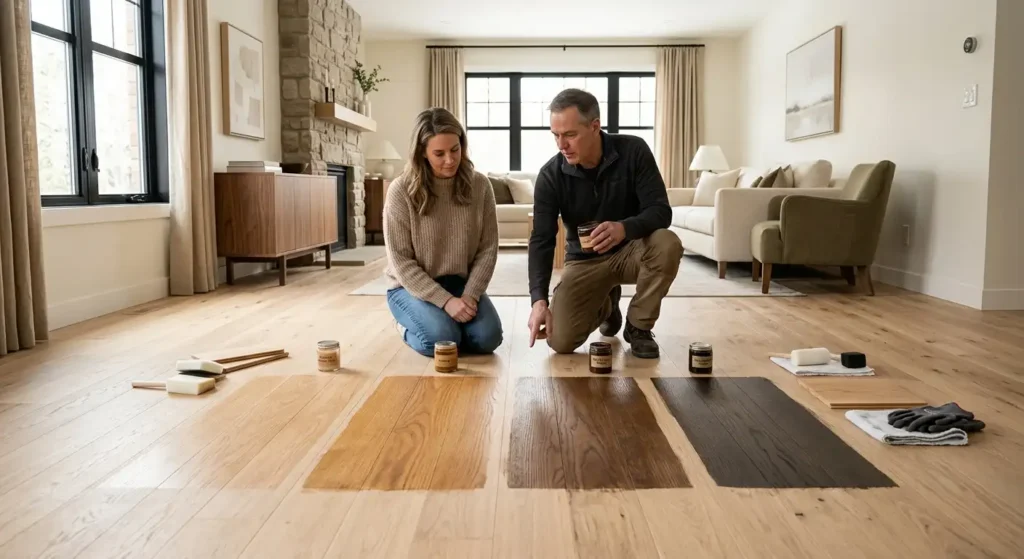
Stain is the decision people agonise over most and research least. Species, width, and finish all get careful attention, and then the colour gets picked from a handful of sample boards in a showroom, under lighting that bears no resemblance to the room the floor is actually going into.
That’s backwards, because stain is the choice you live with most visibly and the one that’s hardest to undo. Hardwood floor staining isn’t paint. It soaks into the wood rather than sitting on top of it, and the colour you end up with is a conversation between the stain and the species beneath it.
What Stain Actually Does
Stain is pigment and dye suspended in a carrier that penetrates the wood fibres. It doesn’t coat the surface, because that’s the job of the protective finish that goes on afterward.
This matters because the wood stays visible through the colour. Grain still reads, variation between boards still shows, and a dark stain doesn’t hide a knotty floor so much as make the knots darker. If you want a surface that conceals what’s underneath, you want paint, and paint on hardwood is a different conversation entirely.
It also means the species controls the outcome as much as the stain does. The same can of walnut stain produces a genuinely different colour on red oak than it does on maple.
How Each Species Takes Stain
This is the point that causes more disappointment than any other, and it’s the one nobody mentions in the showroom. We refinish oak, maple, birch, parquet, and pine, and each behaves differently.
Red Oak
The most forgiving surface for stain, and the most common floor in Ottawa homes. Its open grain absorbs stain readily and evenly, so it takes almost any colour convincingly.
The caution is that red oak carries natural pink and red undertones, and they persist through stain. A grey stain on red oak reads slightly warm rather than neutral, and fighting that undertone is a losing battle. Work with it instead.
White Oak
Tighter grain, and crucially no red undertone. The natural colour sits closer to a warm beige, which is why white oak flooring has become the default for anyone chasing a modern neutral or a true grey. It takes stain well and delivers cooler tones far more reliably than red oak can.
Maple
Beautiful and difficult. Maple is dense and closed-grained, so stain sits unevenly on the surface rather than soaking in cleanly. Dark stains on maple are notorious for going blotchy, with patches of heavy absorption next to areas that barely took colour at all.
It can be done with careful conditioning and a skilled hand, but maple is at its best in natural or very light finishes where its fine, uniform grain is the whole point.
Birch, Parquet, and Pine
Birch behaves somewhat like maple, dense and prone to blotching. Pine is soft and drinks stain unevenly, particularly around knots. Parquet, with its alternating grain directions, takes stain differently in adjacent blocks, producing a chequerboard effect that’s either a feature or a problem depending on your taste.
All three can be stained well, and all three reward a test patch rather than a leap of faith.
Choosing a Colour for an Ottawa Home
Colour is personal, but a few things hold regardless of taste.
- Light floors make a room feel larger and brighter, hide dust well, and show scratches less. They’re forgiving in a way dark floors are not.
- Dark floors are dramatic and elegant, and they show everything: dust, pet hair, footprints, and every scratch. With dogs or small children, that’s a daily reality rather than an occasional annoyance.
- Mid-tone browns are the safest choice and the most popular. They hide the most, they date the slowest, and they work with nearly any wall colour.
- Grey and greige floors peaked several years ago and are cooling. They still look excellent in the right home, but they’re no longer the neutral default.
Our light is the factor nobody accounts for. A stain that looks rich and warm in a July showroom can read as heavy in a January living room with the lights on at four in the afternoon. If your home is north-facing, or if the room doesn’t get direct sun, go lighter than you think you want. If you’ve noticed the pull towards warm wood tone flooring, that instinct is well matched to our climate.
Test on Your Actual Floor
This is the single most useful thing in this article, and it costs almost nothing.
Sample boards in a showroom aren’t your floor. They’re a different piece of wood, from a different tree, under different light, next to different walls. The gap between how a stain looks on a sample and how it looks on your sanded floor is routinely large enough to change your mind.
Ask for test patches. After the floor is sanded and before any stain is committed, a good refinisher applies two or three candidate colours directly to your bare floor, in the actual room, and lets you look at them across a full day. Morning light, afternoon light, evening under your own lamps. What looked perfect at noon can look wrong at seven.
Look at the patches against your walls, your cabinets, and your furniture, because a stain doesn’t exist in isolation and the tone that matters is the one it produces in relation to everything else in the room.
Matching Stain Across the House
Stain rarely stops at one room, and matching it across spaces is where projects get complicated.
If you’re staining stairs alongside floors, do them at the same time and from the same batch. Treads are a different piece of wood from your floor boards, often a different cut and sometimes a different species, and they won’t take stain identically. Doing them together lets the refinisher adjust for that, whereas coming back in two years to match an existing stain is difficult and rarely perfect.
Matching new hardwood to existing hardwood is harder still, because wood ages and ambers, and a floor that’s been down for twenty years isn’t the colour it was when installed. New wood stained to match will drift over time and may take years to settle, so bring a sample and be realistic about what’s achievable. If you’re choosing species from scratch, our guide to choosing the right hardwood is worth reading first.
Where your surrounding floors are engineered hardwood, matching a site-stained solid floor to a prefinished engineered one is a specialised job. The prefinished colour was applied in a factory under controlled conditions, and reproducing it on site needs planning rather than a last-minute attempt.
Why the Finish Changes Your Colour
The finish that goes over your stain isn’t colour-neutral, and you should know that before you sign off on a test patch.
Oil-based polyurethane carries a distinct amber tone that deepens over time. It warms a stain, sometimes considerably, and a cool grey under oil-based finish drifts towards warm within a few years. Waterborne finishes are far clearer and stay closer to the colour you chose, so if you’ve selected a cool or neutral tone, waterborne is almost always the right partner.
Sheen matters too. Higher gloss reflects more light, which makes a colour read lighter, and it also shows every scratch and every speck of dust. Matte and satin are more forgiving on both counts, and satin has become the standard for good reason.
Protecting the Colour You Chose
Your stain sits under the finish, which means protecting the finish protects the colour.
Keep grit off the floor, use felt under furniture, and clean without soaking. Direct sunlight will fade and shift a stain over years, so if a room gets strong afternoon sun, consider blinds or accept that the exposed areas will lighten. The hardwood floor care routine that protects your finish holds the colour along with it, and a properly sealed stain lasts many years before it needs revisiting.
Watch Three Stains Change Across a Day
Nobody chooses stain well from a swatch, and no honest refinisher will let you try. The colour that works is the one you’ve watched shift across a full day in your own room, against your own walls.
We’ll sand a section, put candidate stains directly onto your floor, and let you live with them before anything is committed. Visit our flooring showroom on Colonnade Road to narrow the shortlist first, browse our room scenes gallery for design inspiration, and review our our work portfolio to see how stains behave at full scale.
Ready to get started? Reach out for the flooring services ottawa homeowners trust, or call 613-274-7977 to schedule your free consultation.
