

Hardwood Floor Staining Guide: Choosing the Right Colour for Ottawa Homes
August 31, 2026
Wood Floor Repair in Ottawa: What Can Be Fixed and What Cannot
October 9, 2026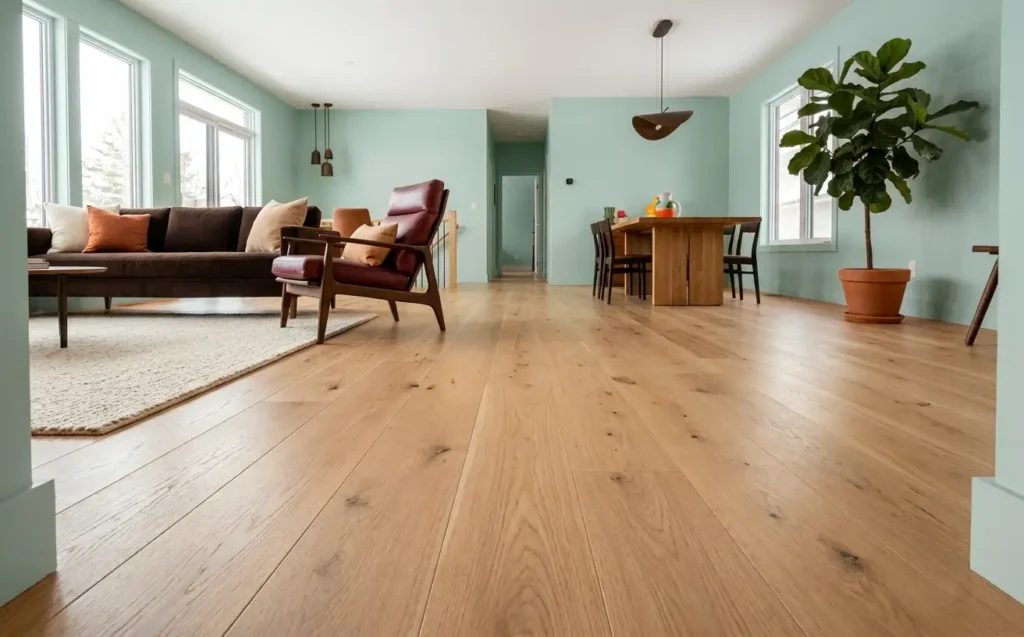
Ten years ago, if you walked into an Ottawa home with new hardwood, the odds were overwhelming that you were standing on red oak. It was the default, it had been the default for generations, and nobody much questioned it.
That’s changed, and changed quickly. White oak has become the species designers specify, renovation shows feature, and homeowners increasingly ask for by name. The shift isn’t fashion for its own sake, because there are real reasons white oak suits the way people are decorating now, and real reasons it suits Ottawa specifically. If you’re weighing your options, our range of hardwood flooring includes white oak in every cut and grade worth considering.
How White Oak Differs from Red Oak
Both are called oak and both look like oak, and the differences only become obvious once you know to look for them.
Undertone
This is the big one, and it explains most of white oak’s rise.
Red oak carries warm pink and reddish undertones naturally. Not dramatically, but persistently. White oak doesn’t, and its natural tone sits closer to a warm beige or light brown with no red in it at all.
That single fact governs what each species can do under stain. A grey stain on red oak fights the pink underneath and ends up reading slightly warm, never truly neutral, while the same grey on white oak reads as grey. If you want a cool or genuinely neutral floor, white oak isn’t merely preferable, it’s close to essential.
Grain
Red oak has open, pronounced, busy grain. It’s handsome and traditional and it hides a great many sins, because a small dent or scratch simply disappears into the pattern.
White oak’s grain is tighter, straighter, and calmer. It reads as more contemporary, and it’s what gives white oak that clean, uncluttered look you see in modern interiors. The trade-off is real: a quieter grain shows wear slightly more readily, because there’s less visual noise to hide it in.
Hardness and Water Resistance
White oak is marginally harder than red oak, which helps in a busy household without being a dramatic difference.
The more interesting difference is structural. White oak’s cellular structure is closed, making it considerably less permeable than red oak. It’s the reason white oak is used for wine and whisky barrels and red oak isn’t. In a floor, that closed structure means slightly better tolerance of spills and humidity, which matters more here than it would in a milder climate.
Why It Suits Our Climate
Ottawa asks a great deal of a wood floor. Every hardwood floor in this city expands and contracts across the year, and the question is only how gracefully it does so.
White oak’s tighter, less permeable structure means it moves somewhat less than red oak under the same conditions. It isn’t immune, and no solid wood is, but it’s marginally more stable, and across a wide floor that margin shows up as fewer gaps come February. Our ottawa climate flooring guide covers what our humidity swing does to wood more broadly, and understanding the risk of hardwood moisture problems is worth doing before any solid wood installation.
Light matters too. A floor that reads light and neutral bounces what daylight there is around a room instead of absorbing it, and white oak in a natural or lightly toned finish does that as well as any hardwood available.
The Finishes That Suit It
White oak is versatile in a way that surprises people who assume it only does one thing.
Left natural under a clear finish, its beige-brown reads warm without being orange, and it’s about as timeless a floor as you can lay. A waterborne finish keeps it clear, while an oil-based one will amber it noticeably over the years.
Whitewashes, wire-brushed finishes, and pale stains all work because there’s no red undertone to fight through. That’s the Scandinavian-influenced look that dominated the past decade, and white oak is essentially the only common species that achieves it convincingly.
The current direction of travel is warmer. After years of grey and greige, homeowners are moving back towards warmth, and white oak takes a mid-brown or honeyed stain beautifully. If you’ve noticed the pull towards warm wood tone flooring, white oak is the species doing most of the work in those rooms.
And it takes dark stains cleanly, without the blotching that plagues maple. A dark white oak floor is dramatic and elegant, and it will show every speck of dust and every scratch, which is a fair price if you want it enough.
Grade, Cut, and Width
Species is only the first decision, and three more shape what you actually end up with.
- Grade determines how much colour variation, knotting, and character the boards carry. Select and better grades are uniform and calm, while character or rustic grades have knots, mineral streaks, and colour swing.
- Cut affects appearance and stability. Plain-sawn is standard and shows the familiar cathedral grain. Rift and quarter-sawn boards show straight, linear grain and move less across their width, which is useful in our climate, though they cost more.
- Width changes the feel of a room more than almost anything else, since wide boards mean fewer seams and a calmer, more expansive floor. Our guide to wide plank flooring covers the trade-offs.
- Sheen finishes the picture. Matte and satin hide wear and dust, while higher gloss shows both and makes the colour read lighter.
Solid or Engineered
You don’t have to choose between white oak and stability, because engineered white oak exists and it’s excellent.
Solid white oak is a single piece of wood through its full thickness. It can be sanded and refinished many times, which means a floor laid now can still be in service in seventy years. It also moves with humidity, which is the price of that longevity.
Engineered hardwood puts a real white oak wear layer over a cross-laminated core. The surface is genuine white oak, indistinguishable once installed, but the core holds the board dimensionally still through our humidity swings. It can go over concrete, over radiant heat, and into a basement, none of which solid wood does reliably. Premium options like lauzon engineered hardwood are built specifically for Canadian conditions and pair beautifully with white oak’s natural stability.
The catch is the wear layer. A thick one takes a full sanding, sometimes more than once, while a thin one can’t take any. That number is the single most important specification on an engineered product, and our comparison of engineered hardwood vs solid hardwood sets out the trade-off for our climate.
What the Premium Buys You
White oak costs more than red oak. It’s in higher demand, supply is tighter, and the market has priced that in. Rift and quarter-sawn cuts, wide planks, and premium grades push it higher still.
Whether the premium is worth paying depends on what you want. If you’re after a warm, traditional floor with plenty of grain, red oak does that beautifully and costs less, and choosing it isn’t a compromise. If you want a cool or neutral tone, a calm contemporary grain, or the specific look white oak alone produces, red oak won’t get you there at any price, and the premium is simply the cost of the thing you actually want.
If you’re weighing species from scratch rather than assuming oak, our guide on how to choose hardwood flooring covers the full range, and our overview of hardwood for every home looks at how species suits different styles of house.
Installation Matters as Much as Species
The most beautiful white oak will disappoint if it’s laid badly. Solid boards need acclimatisation and a flat, dry subfloor, and engineered products need the right method for the substrate they’re going over. Professional floor installation handles all of that as a matter of course, and our pre-installation checklist covers how to prepare the room before the crew arrives.
Living with White Oak
White oak is hardwood, and it asks what any hardwood asks.
Keep grit off it, because grit is what actually abrades a finish. Wipe spills rather than letting them stand, use felt under furniture, and mind the entryway in winter, since road salt is harder on a finish than almost anything else that comes through the door. Our guide to winter floor maintenance covers the seasonal habits that matter most.
Manage humidity if you can. A humidifier in the dry months keeps the boards from shrinking as far, and it’s the single most useful thing you can do for a solid wood floor here. Sensible hardwood floor care isn’t complicated, and it determines whether your floor still looks right in fifteen years.
When the finish eventually wears, white oak sands back beautifully, and professional floor refinishing is what makes hardwood the only floor that improves rather than expires.
Put White Oak Next to Red Oak and Decide
Every photograph of white oak online has been colour-corrected, and every one was taken under lighting nothing like your living room in January.
The only way to judge it is to look at real boards, in the width and grade and finish you’re considering, ideally against a sample of your own wall colour. Visit our flooring showroom on Colonnade Road to compare white oak against red oak side by side and see the difference between plain-sawn and rift cuts in the flesh. Browse our room scenes gallery for design inspiration and review our our work portfolio for finished white oak floors.
Ready to get started? Reach out for the flooring services ottawa homeowners trust, or call 613-274-7977 to schedule your free consultation.
