
White Oak Flooring: Ottawa’s Most Popular Hardwood in 2026
September 28, 2026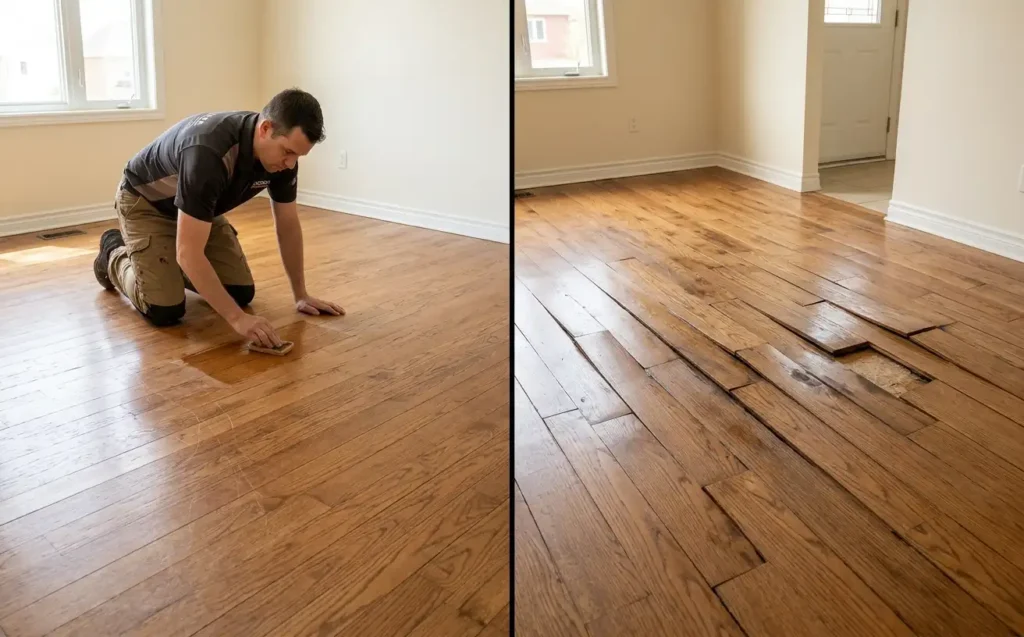
Something has gone wrong with your floor. A board has split, a section has cupped after a leak, there’s a gouge where the fridge was dragged out, or a tread creaks loudly enough to wake the house.
The instinct is to assume the worst, and the worst is expensive. But most wood floor problems are repairable, often far more cheaply and far less disruptively than you’d expect. Wood floor repair is a real discipline, and knowing what falls inside its limits saves you from replacing a floor that only needed fixing.
What Repair Actually Covers
Repair isn’t one thing. It ranges from filling a gap to lifting out and replacing individual boards, and the right approach depends entirely on what’s wrong.
Surface damage, meaning scratches, dents, gouges, and worn finish, is almost always fixable. Individual board damage, meaning splits, cracks, and water-stained boards, is usually fixable by replacing the affected boards. Movement problems, meaning gaps, cupping, crowning, and buckling, are sometimes fixable and sometimes a symptom of something that needs fixing first. Structural problems, meaning squeaks and loose boards, are fixable, but the fix is underneath rather than on the surface. And widespread failure, meaning extensive water damage, rot, or a floor sanded past its limit, is where repair ends.
The underlying material matters too. Solid hardwood flooring has more surface to work with than engineered hardwood, and that single fact changes what’s possible.
The Repairs You Can Usually Get
Most of what goes wrong with a wood floor has a straightforward answer.
Surface Damage
Scratches that haven’t gone through the finish into the wood can often be dealt with easily. Where the finish has been abraded across a whole room, a screen and recoat restores it, lightly abrading the existing finish and applying a fresh coat over the top without sanding to bare wood. It’s faster, cheaper, and far less disruptive than a full refinish.
Where the damage has gone into the wood itself, sanding is the route. Hardwood floor sanding takes the floor back to bare wood, removing scratches, stains, and gouges along with the old finish, and the floor is stained and refinished afterward. We refinish oak, maple, birch, parquet, and pine, and a floor that looked beyond hope routinely comes back looking new.
There’s also a sandless technique for floors where the finish has failed but the wood beneath is sound. It restores the surface with far less disruption and at lower cost, so ask about it rather than assuming a full sand is necessary.
Individual Boards
This is the repair most homeowners don’t know exists, and it’s the one that most often saves a floor.
A single split, cracked, or badly damaged board can be lifted out and replaced without touching the boards around it. The damaged board is cut out, the tongue and groove of the neighbours are preserved or trimmed as needed, and a new board is fitted in. The same works for a small section: a patch where a radiator leaked, a run of boards damaged when a wall came out, or an area stained by a pet accident that soaked through.
The complication is always matching. New wood isn’t the colour of old wood, because wood ambers with age and light, and a board replaced today and finished to match will still differ slightly. That’s why board replacement is almost always paired with floor refinishing across the surrounding area or the whole room, so old and new get the same stain and finish at the same moment.
Where your floor is a common species and a common width, matching is straightforward. Where it’s unusual or discontinued, sourcing the replacement becomes the hard part. Keeping a box of offcuts after any installation is one of the most useful things you can do, and almost nobody does it.
Squeaks and Loose Boards
Squeaks are almost never a problem with the floorboards themselves. They’re a problem with what’s under them.
A squeak means two surfaces are moving against each other: a board against a subfloor, a subfloor against a joist, or a nail moving in its hole. The fix depends on which, and on whether you can reach it from underneath. Where there’s access from below, such as an unfinished basement ceiling, the repair is straightforward and non-destructive, using shims, adhesive, or fasteners from beneath without touching the surface at all. Where there’s no access, the fix comes from above, fastening through the surface and concealing the fastener.
Loose boards and popped nailheads follow the same logic. The nail is moving because the wood around it has dried, shrunk, and released it, so hammering it back is a temporary fix at best.
Movement Problems: Fix the Cause First
Gaps, cupping, and crowning are all movement problems, and here the repair is only half the job.
Gaps between boards open when wood shrinks, which in Ottawa means winter. The heating comes on, the air dries out, the boards give up moisture and contract, and gaps appear. Come summer they close again. Seasonal gapping that comes and goes is normal, and filling it in February means the filler gets crushed and pushed out in July. Permanent gaps, the ones that never close, are a different matter and can be filled properly. Our ottawa climate flooring guide explains why this cycle is so pronounced here.
Cupping is when boards rise at the edges and dip in the middle, and it means moisture is coming from below. Crowning is the reverse, and it often means a cupped floor was sanded flat before it had dried out, which is an expensive mistake.
Here’s the part that matters most: sanding a cupped floor while it’s still wet locks the damage in. The wood must be allowed to dry and return to its normal dimension first, and only then can it be assessed, which can take weeks. Any contractor willing to sand a freshly cupped floor immediately is a contractor to walk away from.
Buckling, where boards lift clear of the subfloor entirely, usually means either serious moisture or a missing expansion gap, and both need diagnosing before anything else happens. Our guide to hardwood moisture problems walks through the causes and what to do about them.
Water Damage: It Depends on How Much
Water decides most repair-or-replace calls, and the answer depends on scope and on how long it sat.
A contained spill on a sealed floor, wiped up quickly, usually does nothing at all. That’s what the finish is for.
Water that sat for a day or two and reached the wood will stain and may cup the boards, and this is frequently repairable. Dry the floor thoroughly, let it return to its normal dimension, then sand and refinish, replacing individual boards where the staining went too deep.
Water that sat for a week, or came from below, or soaked the subfloor, is a different problem. At that point the subfloor may be compromised and there’s a mould question underneath, and replacing the surface without addressing what’s beneath it puts a beautiful new floor over a problem that hasn’t gone away.
Where Repair Ends
Being honest about the limits is what makes the rest of this credible.
Sometimes there’s no material left. Hardwood can be sanded a finite number of times, because there’s only so much wood above the tongue, and a floor refinished three or four times may simply have run out. Once sanding would expose the tongue, the floor is finished, and engineered floors hit this limit far sooner.
Sometimes the failure is structural. Where the subfloor has gone, where rot has set in, or where damage is widespread rather than localised, repair stops being economical and you’re just patching a floor that needs replacing. At that point a full floor installation is the honest answer, and our pre-installation checklist covers how to prepare for one.
Sometimes there are simply too many patches. A floor repaired in a dozen places begins to look like a floor repaired in a dozen places, however good the individual repairs were.
And sometimes you’ve simply had enough. The floor is technically fine and you’ve hated it for a decade, which is a legitimate reason that doesn’t need justifying. Our guide to the signs replace hardwood floors covers the full picture on when replacement is the right call.
Repairing Stairs
Stairs deserve a separate mention because they fail differently.
Treads take enormously concentrated wear and they’re the first surface in the house to show it. A worn tread can be refinished and a cracked one can be replaced, but the awkward geometry means the labour runs higher than on flat floors.
Where your treads are carpet-grade lumber rather than hardwood, there’s nothing to repair, and recapping with new hardwood is the route instead. A full stairs and railings renovation covers the options between refinishing, recapping, and replacing.
Preventing the Next One
Most repairs trace back to something preventable, and two habits account for the majority of them.
Grit is the main culprit, acting like sandpaper underfoot and arriving on boots from November through April. Mats at every entrance do more for your floors than any product you can buy, and our guide to winter floor maintenance covers the full set of seasonal habits that matter here.
Humidity is the second. Solid wood shrinks in our dry winters and expands in our humid summers, and a humidifier through the heating season prevents most of the gapping people call us about. Consistent hardwood floor care keeps small problems from becoming repairs, and it costs almost nothing.
Before You Assume the Worst, Let Us Look
Almost nobody can tell by looking whether their floor needs a screen and recoat, a full sand, a few boards replaced, or a full replacement. The difference between those is thousands of dollars, and it’s settled in a short visit.
We’ll tell you plainly what your floor needs, including when the honest answer is that it doesn’t need much. Visit our flooring showroom on Colonnade Road to see finishes and species, browse our room scenes gallery for design inspiration, and review our our work portfolio for restored floors.
Looking for Ottawa’s trusted floor repair specialists? Contact Continental Flooring today or call 613-274-7977 to book your free in-home assessment.
