

Cork Flooring: A Sustainable and Stylish Choice for Your Ottawa Home
July 8, 2025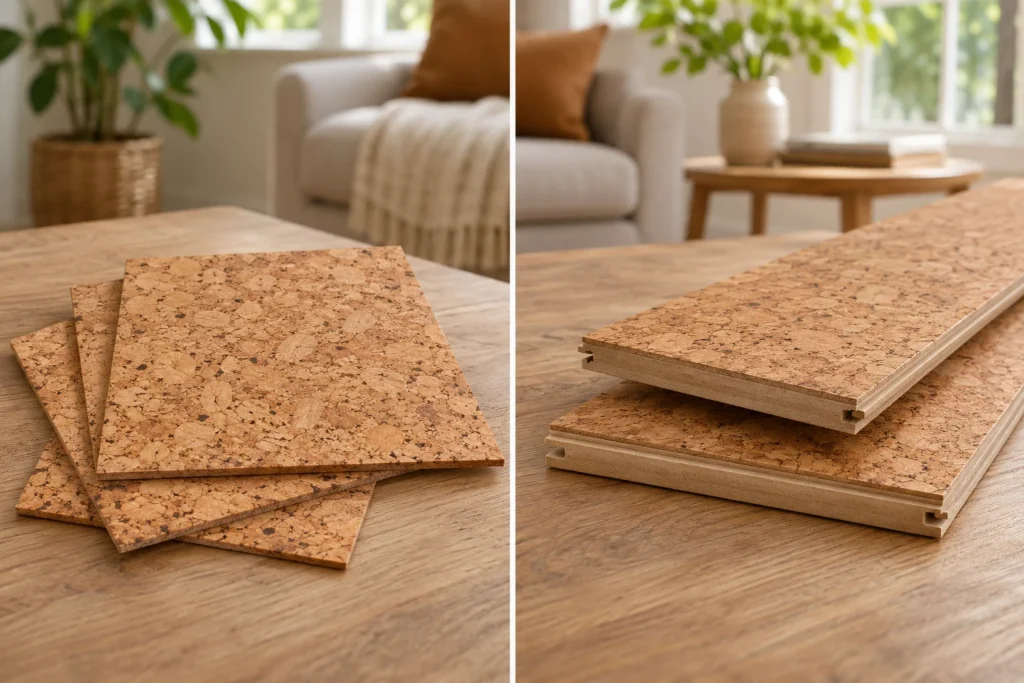
Two cork floors can look similar in a showroom and require very different preparation at home. One uses tiles bonded to the surface beneath them. The other uses planks joined together as a floating floor. Choosing between them means looking beyond the colour and considering the room, the existing floor and the complete installation system.
If you are comparing cork flooring in Ottawa, Continental Flooring’s cork flooring selection includes glue-down tiles and click-together floating planks. Neither format is automatically the better choice for every home. The useful question is which specific product suits the conditions in your room.
Glue-Down Cork and Floating Cork: The Practical Difference
With glue-down cork, the tile is bonded to an approved substrate using the specified adhesive system. With click-together floating cork, the planks connect to one another rather than being bonded across their entire underside. The exact construction, edge profile and installation instructions belong to the product you select.
A sample’s surface does not tell you everything about the floor. Turn it over, look at the edge and ask to see the installation instructions for that exact model. Two products described as cork may have different cores, finishes and requirements.
| Decision | Glue-down tiles | Floating planks |
|---|---|---|
| Connection | Tiles bond to an approved substrate. | Planks join together as a floating assembly. |
| Preparation to confirm | Surface condition and compatibility with the specified adhesive. | Subfloor condition, permitted underlay and movement space. |
| Finished height | Check the complete tile, adhesive and preparation build-up. | Check plank thickness and any permitted separate layers. |
| Existing floor | Confirm whether it can remain and receive this system. | Confirm whether this product permits installation over it. |
| Future damage | Ask how an individual bonded tile would be repaired or replaced. | Ask what access and dismantling a plank replacement could require. |
The table is a way to compare proposals, not an installation specification. There is no universal adhesive, underlay or moisture limit that can safely be assigned to all cork floors.
Check the Room and the Surface Beneath the Cork
Identify the surface beneath your flooring
“It is going over the old floor” leaves several questions unanswered. What is the old floor? What supports it? Is it firmly attached, dry and suitable for the proposed system? A floating floor does not remove the need to evaluate the surface beneath it, and adhesive does not correct every substrate problem.
Continental’s cork page discusses concrete and plywood, but that does not approve every concrete slab or plywood assembly. Tell the person helping you choose about previous leaks, visible damage, uneven areas and any rooms below the installation. Ask how suitability will be checked before ordering.
Check doors, transitions and fixed features
Measure the relationship between the proposed floor and neighbouring surfaces. A product that looks ideal in isolation may create an awkward doorway transition once preparation materials and other required layers are included. Ask how the finished height will meet the hall, tile edge, stair landing and exterior door.
For a floating system, clarify the manufacturer’s requirements around walls and fixed features. Do not assume that a tight fit beneath built-in cabinetry is acceptable. For either system, agree on the transition details before the installation is priced.
Discuss moisture and heating separately
A comfortable feel underfoot does not establish suitability for a bathroom, a damp basement or a room with a history of leaks. Explain how the space is used and ask for approval for that application. If radiant heating is present, the exact flooring and heating combination needs confirmation.
Likewise, do not transfer a moisture or temperature limit from one cork product to another. Request the current instructions for the model being considered and keep them with the purchase paperwork.
How to Compare Cork Options in Three Different Rooms
A home office beside an existing hallway
Imagine that comfort is the reason for considering cork, but the office door already clears the current floor by very little. The first comparison should be the total finished height of each proposed assembly, including any preparation. Choosing solely by the visible sample thickness could miss the detail that determines whether the door and transition work.
Also explain how the chair will be used. Ask for the manufacturer’s recommendations for furniture protection and rolling loads rather than assuming every cork finish behaves the same way.
A kitchen renovation that keeps the existing cabinets
Here, access around appliances and fixed cabinets matters as much as colour. Before choosing a floating plank, discuss where it will stop and how the required movement allowances will be maintained. Before choosing a bonded tile, discuss the existing surface and what preparation the adhesive system requires.
Neither answer follows automatically from the word “kitchen.” The selected product’s application guidance and the room’s actual conditions must support the choice.
A room with a concrete subfloor you know little about
If you do not know whether the slab has had moisture problems, record that uncertainty. A new floor should not be selected on the assumption that covering the surface resolves what is happening beneath it. Ask what assessment is required and how the findings could change the proposed system or preparation work.
Compare the Full Installation Cost
Put each option on the same basis: the same room, the same area and the same expectations at the edges. Ask whether the proposal accounts for removing the existing surface, preparing the substrate, the specified installation materials and finishing the transitions. These are questions to clarify, not a statement that every item is included in Continental’s pricing.
It is also worth discussing future care before choosing. What cleaning products are permitted? Is a further finish treatment specified? How would a damaged area be handled? Keep a record of the exact product and ask whether retaining spare material would be sensible for the project.
For a broader look at the material’s appeal, read our guide to cork flooring in Ottawa. This installation-system decision should then come back to the room and the selected product, rather than a general list of cork benefits.
What to Bring When Comparing Cork Samples
- Room measurements and photographs of adjoining floor heights.
- The existing surface and, if known, the subfloor beneath it.
- Any leak history, uneven areas or radiant heating.
- Details of fixed cabinetry, heavy furnishings and rolling chairs.
- The model names of the glue-down and floating products you want to compare.
These details make the conversation more useful than asking which cork floor is best in general. They help narrow the choice to a system whose requirements can actually be met in your home.
Visit Continental Flooring at 48 Colonnade Rd in Ottawa to discuss glue-down and floating cork options. Contact us for a free in-home consultation or call 613-274-7977.
