

Warm Wood Tones Are Back: The Flooring Trend Taking Over Ottawa Homes
June 10, 2026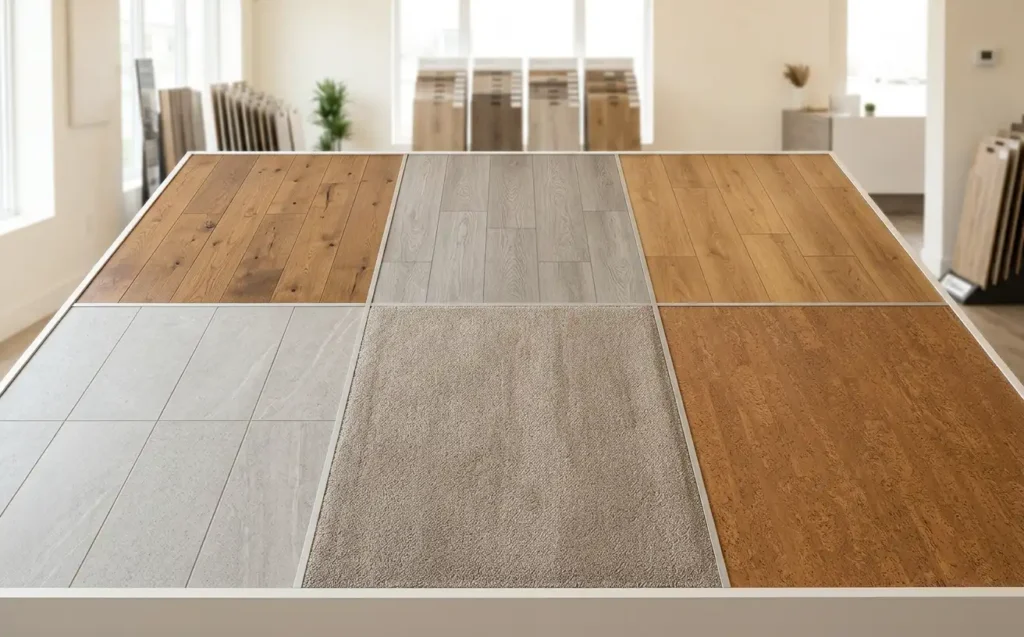
Most flooring advice tells you to think about your lifestyle, consider your budget, and reflect on how you use the room. That’s all true, and it’s all useless when you’re standing in a showroom trying to remember whether laminate can go in a basement.
What you actually need is a straight comparison. Which materials survive water. Which can be refinished rather than replaced. Which are warm underfoot and which are cold. What each costs and how long it lasts. This guide sets out different flooring types against the criteria that genuinely separate them, so you can rule things out quickly and spend your time on the ones that survive the cut.
The Comparison at a Glance
Here’s the short version before the detail.
- Solid hardwood flooring: the longest-lasting floor available, refinishable many times, warm, expensive, and vulnerable to water. Not for basements or bathrooms.
- Engineered hardwood: real wood surface, far more stable in our humidity, works over concrete and radiant heat, refinishable once or twice if the wear layer is thick enough.
- Laminate flooring: affordable, hard-wearing, convincing to look at, and only waterproof if the core is.
- Vinyl flooring: fully waterproof, warm, quiet, soft underfoot, and the most forgiving floor in the house. Can’t be refinished.
- Ottawa tiles: the hardest and most water-tolerant surface there is, lasts decades, and is cold and unforgiving to stand on.
- Carpet flooring: the warmest and quietest floor, cheapest to install, and the only one with a hard expiry date.
- Cork: warm, soft, quiet, and sustainable. Softer than wood, so it dents, and it needs sealing.
- Bamboo: hard, sustainable, and inexpensive relative to hardwood. Quality varies enormously between products.
The Criteria That Actually Separate Them
Four questions decide almost every flooring choice, and they’re worth taking in order.
Water Tolerance
Start here, because it eliminates options faster than anything else.
Fully waterproof means the material doesn’t care about standing water, and that covers luxury vinyl, porcelain and ceramic tile, and laminate with a genuinely waterproof core. These are the only materials that belong in a basement or a bathroom without qualification. For kitchens and entryways specifically, waterproof vinyl flooring is the forgiving choice.
Water-resistant means it survives a spill you notice and fails on one you don’t. Engineered hardwood sits here, handling humidity far better than solid wood while still suffering under standing water.
Not water-tolerant covers solid hardwood, standard laminate, and carpet. Solid hardwood cups and warps under the kinds of hardwood moisture problems that come with leaks or persistent humidity. Standard laminate has a fibreboard core that absorbs water, swells, and never returns to shape. Carpet traps moisture and grows mould, which is why it doesn’t belong below grade. Our guide to the best flooring for basements works through the below-grade options in detail.
Refinishability
This decides what a floor actually costs across twenty years, and almost nobody asks about it.
Solid hardwood can be sanded back and refinished several times across its life, with each refinish costing a fraction of a replacement. That’s why century homes in the Glebe still have their original floors, and it’s the entire economic case for hardwood. Professional floor refinishing is what makes this possible, and it’s a service nothing else on this list can take advantage of.
Engineered hardwood can be refinished if the wear layer is thick enough, and that single specification is the difference between a floor that lasts thirty years and one that lasts fifteen.
Everything else is replaced rather than refinished. Laminate, vinyl, tile, and carpet all have finite lives, and when they end, they come up. Tile’s life is very long, so this matters less. Carpet’s is short, so it matters a great deal.
Warmth and Comfort
Rarely on anyone’s spec sheet, and consistently the thing people complain about afterwards.
Carpet and cork flooring are the warmest and softest, absorbing sound and feeling forgiving underfoot. Vinyl and laminate sit in the middle, and vinyl in particular is warmer and quieter than most people expect, which is part of why it has taken so much ground. Hardwood is cooler than vinyl but not cold, and it feels solid in a way people respond to.
Tile is cold, properly cold, in a way that becomes a daily fact of life through an Ottawa winter unless there’s heat beneath it. It’s also hard, and if you cook for hours at a stretch you’ll feel a tile kitchen floor in your knees.
Cost Over Time
Purchase price is the least useful number in flooring, and it’s the one everyone compares.
Carpet and laminate are cheapest to buy and install. Vinyl sits slightly above. Engineered hardwood costs more. Tile is expensive to install even when the material isn’t, because the labour is skilled and slow. Solid hardwood is the most expensive up front.
Now run it over twenty-five years. The carpet has been replaced twice, possibly three times. The laminate has been replaced once. The vinyl has probably been replaced once. The tile is still there. And the hardwood has been refinished once, at a fraction of the cost of a replacement, and looks new. Neither number is wrong, but if you’re staying in the house, the second one reverses the ranking almost completely.
Where Each Material Belongs
Once you’ve applied those four criteria, the room decides the rest.
Kitchens want water tolerance and hardness, so tile and luxury vinyl are the strongest candidates. Hardwood works if you’re attentive, and if you’re still weighing options, our comparison of luxury vinyl plank vs hardwood puts the two side by side.
Basements want waterproofing above all: LVP, porcelain tile, or waterproof-core laminate. Solid hardwood and carpet don’t belong there. Bathrooms want tile or LVP, and that’s the whole list.
Living areas and bedrooms are where hardwood earns its place, and where carpet still makes sense if quiet and warmth matter to you. Entryways take the full force of winter, and salt and slush punish everything, so porcelain tile and LVP are the two that survive it. Condos add their own constraints around sound and subfloor, covered in our guide to flooring for ottawa condos.
Stairs are their own question, with wood, carpet, or a runner over wood, and the answer depends on noise, footing, and what’s under your existing carpet. Our stairs and railings page covers the options.
Two Materials Worth a Second Look
Cork and bamboo get overlooked, and both deserve better.
Cork is warm, quiet, soft underfoot, naturally antimicrobial, and genuinely sustainable, since the bark regenerates and the tree survives. It dents under heavy furniture and needs resealing periodically, but in a bedroom, a study, or anywhere you want quiet, it’s superb.
Bamboo flooring is technically a grass, growing back in a few years rather than a few decades, and strand-woven bamboo is harder than most hardwoods. Quality varies enormously between products, though, and a cheap bamboo floor is a poor floor. If sustainability is driving your decision, our broader look at eco friendly flooring covers both properly.
What Each One Asks of You
Maintenance load varies more between materials than most people realise, and it’s worth factoring in before you choose.
Tile is the least demanding: sweep, mop, and attend to the grout occasionally. Vinyl and laminate are nearly as easy, needing regular sweeping to keep grit off the wear layer, damp mopping, and no steam.
Hardwood asks the most and gives the most back. Grit control, felt under furniture, humidity management through the heating season, and eventual refinishing. Our guide to winter floor maintenance covers the seasonal habits that matter most in Ottawa. Cork needs resealing on a schedule, and carpet needs vacuuming and stain response, with the pile crushing regardless of what you do.
Consistent hardwood floor care is the difference between a hardwood floor that needs refinishing in eight years and one that needs it in twenty. For every other material, maintenance simply delays the replacement date.
Installation Decides as Much as Material
A great material installed badly is a bad floor. Subfloor prep, acclimatisation, and the right fastening method all shape how long any of these materials actually last. Professional floor installation handles each of these as a matter of course, and our pre-installation checklist covers how to prepare the room before the crew arrives.
Tell Us the Rooms and We’ll Cut the List
Every material here looks good in a photograph. What you can’t judge from a screen is how a floor feels under a bare foot, how heavy a tile is in your hand, or whether a laminate reads as convincing wood or as a picture of wood.
Bring us the rooms you’re flooring and how you actually use them, and we’ll tell you honestly which materials belong on your shortlist and which don’t. Visit our flooring showroom on Colonnade Road to compare all of these side by side, browse our room scenes gallery for design inspiration, and review our our work portfolio to see them installed at full scale.
Ready to get started? Reach out for the flooring services ottawa homeowners trust, or call 613-274-7977 to schedule your free consultation.
