
Porcelain Tile vs. Ceramic Tile: Which Is Better for Ottawa Homes?
August 14, 2026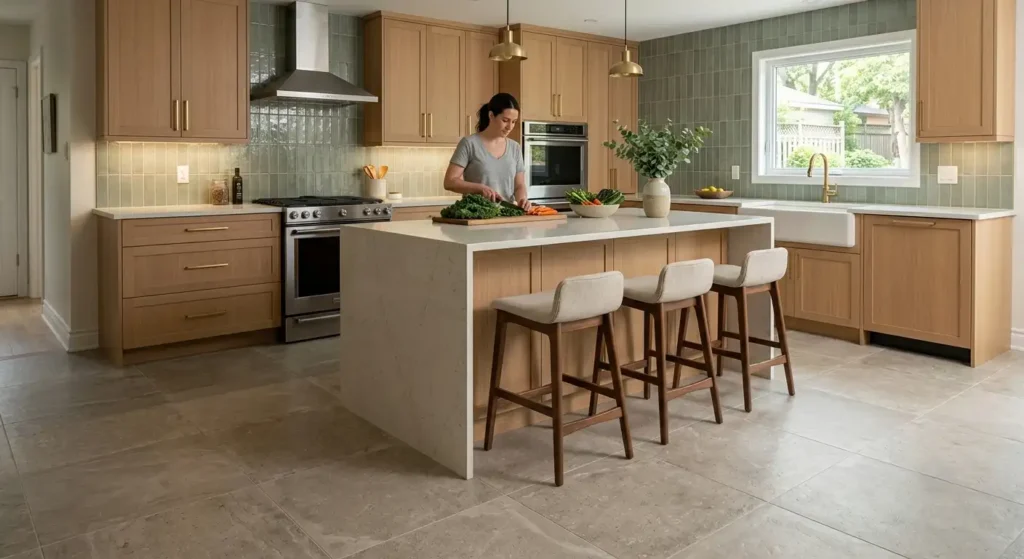
Your kitchen asks more of a floor than any other room in the house. It gets water, it gets grease, it gets dropped pans and dragged chairs, it gets stood on for hours at a stretch, and it gets seen by everyone who visits. Very few materials handle all of that at once, which is why kitchen tile has held its position for as long as it has.
The question is rarely whether to use tile. It’s which tile, in which format, and where. Floor and backsplash are two different problems with two different right answers, and treating them as one decision is where most kitchen projects go sideways.
Start with the Floor, Not the Backsplash
The backsplash is the fun part, so it’s where most people start. It’s worth resisting that instinct.
The floor is the harder decision and the more expensive one to get wrong. It has to survive spills, dropped cookware, chair legs, and years of standing traffic in front of the sink and the stove, and it sets the tone the rest of the kitchen has to work with. Choose the floor first, then choose a backsplash that answers it.
The floor is also the surface you stand on while cooking, and that deserves a moment’s honesty. Tile is hard, and if you cook for hours at a time you’ll feel it in your knees and your lower back. A mat in front of the sink solves it, but it should be a decision rather than an afterthought.
Your Material Options
Four materials cover almost every kitchen in Ottawa, and each one belongs somewhere different.
Porcelain
For a kitchen floor, porcelain is usually the answer. Porcelain tile is denser and harder than ceramic, fired hotter, and it absorbs almost no water, so in a room where things get spilled and dropped that density is doing constant work. A dropped pot is far more likely to chip a ceramic tile than a porcelain one.
Porcelain also comes in large formats, and large tiles are worth taking seriously in a kitchen. Fewer tiles means fewer grout lines, and grout lines are where kitchen floors get dirty. A 600 by 600 millimetre tile carries meaningfully less grout per square metre than a 300 by 300, and every joint is a place for grease and crumbs to collect.
Texture matters too. A polished porcelain floor looks superb and turns dangerous the moment water hits it, so choose a matte or lightly textured surface. Textured tiles are both water and slip-resistant, which is exactly what a kitchen needs.
Ceramic
Ceramic is often dismissed as the cheaper option, which sells it short. On a backsplash it’s frequently the better choice.
A backsplash takes no foot traffic, no impact, and no standing water, so porcelain’s hardness is irrelevant there. Ceramic is lighter, which matters on a vertical surface, and it’s easier to cut around outlets and awkward corners. More importantly, it gives you far more to look at, since the glaze range is wider and modern ceramic designs are nearly identical to natural marble and other natural products.
Marble
Marble tiles remain the most luxurious surface you can put in a kitchen, and they carry a genuine premium at resale.
The caution is that marble is porous and reactive. Lemon juice, vinegar, wine, and tomato will etch it, leaving dull marks in the polished surface that don’t wipe away, and sealing helps without eliminating the problem. That makes marble a difficult kitchen floor and an excellent backsplash, provided it isn’t directly behind the stove where splatter lands hardest.
Wood-Look Porcelain
If you’ve been torn between the look of hardwood and the practicality of tile, this is the crossover worth knowing about.
Wood-look porcelain is tile manufactured in plank format with printed wood grain, and it’s come a very long way. Good examples are convincing at normal viewing distance, and they give you complete water tolerance with no swelling and no concern about the humidity swings your kitchen sees between August and January.
It works when you want wood everywhere on the main floor but the kitchen makes you nervous. A plank tile running in the same direction as the hardwood elsewhere bridges the two zones without the visual break of switching to a square tile. Where it falls short is underfoot, because it’s still tile: still hard, still cold without heat beneath it, and without the give of real wood. Talk to us about what’s currently available before you set your heart on a particular look.
Weighing Tile Against Luxury Vinyl
Tile isn’t the only sensible kitchen floor, and luxury vinyl plank has become the serious competitor for exactly this room. It’s warmer and softer underfoot, quieter, more forgiving of dropped glassware, and it costs less to install.
We’ve made the full case elsewhere, and if you’re genuinely torn, read waterproof vinyl flooring before you decide. The short version is that tile wins on lifespan, heat resistance, and sheer hardness, while LVP wins on comfort, cost, and how it feels to stand on for an hour. Neither is wrong, and a kitchen that gets heavy daily cooking has different needs from one that mostly makes coffee.
Details That Decide Whether It Works
A few practical points separate a kitchen tile floor that succeeds from one that disappoints.
- Grout colour matters more than tile colour. White grout in a kitchen won’t stay white, so choose a mid-tone and specify a stain-resistant grout if the budget allows.
- Layout should be planned around the sightline from your main entrance into the kitchen, not from whichever corner installation happens to start.
- Substrate preparation determines everything, since tile is unforgiving of a subfloor that flexes. Cracked grout a year later is almost always a substrate problem rather than a tile problem.
- Order ten percent more than you need. Matching a discontinued tile three years later after a plumbing repair is a miserable experience.
Professional tile installation is worth it here more than almost anywhere, because kitchens have appliances to cut around, thresholds to manage, and a floor you’ll scrutinise daily for the next twenty years. Our pre-installation checklist covers how to prepare the room before the crew arrives.
Keeping a Kitchen Floor Clean
The tile itself is close to maintenance-free. The grout is where the work is.
Grease and crumbs collect in grout lines faster in a kitchen than anywhere else in the house, which is the argument for larger formats and for a mid-tone grout colour. Sweep regularly, mop with a neutral cleaner rather than anything acidic, and seal the grout on installation.
If you’ve chosen marble anywhere, treat it more carefully. Acidic spills need wiping immediately, and resealing on a schedule is the difference between a surface that ages well and one that etches within a year.
Bring Your Cabinet Samples In
Tile choice gets much easier when we can see the room. Cabinet colour, counter material, natural light, and how much cooking actually happens in the space all change the answer, and none of that survives a photograph.
Visit our flooring showroom on Colonnade Road with your cabinet and counter samples and we’ll lay tile options against them, so you’re seeing the combination rather than imagining it. Browse our room scenes gallery for design inspiration and review our our work portfolio for finished Ottawa kitchens.
Ready to get started? Reach out for the flooring services ottawa homeowners trust, or call 613-274-7977 to schedule your free consultation.
