
Vinyl Plank Flooring Installation in Ottawa: DIY vs. Professional
September 14, 2026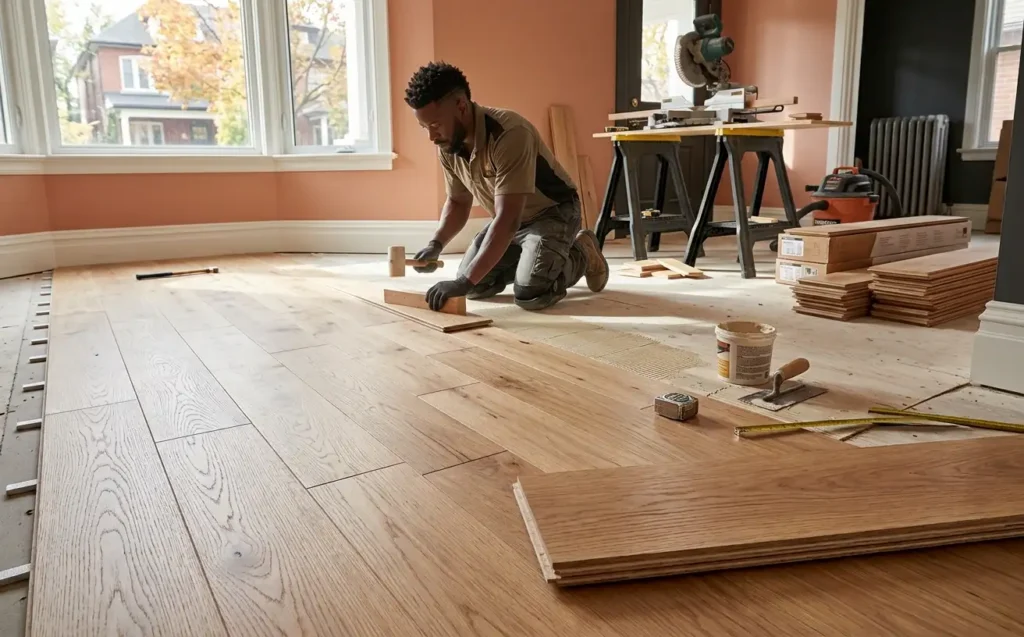
Engineered hardwood exists because of a problem, and in Ottawa that problem is our climate. Solid wood expands through a humid August and contracts through a January that strips moisture out of the air, and across a wide floor that movement is enough to open gaps, cup boards, and cause real grief.
Engineered flooring solves it structurally. A real hardwood flooring wear layer sits on top of a cross-laminated core, and because the core layers run in alternating directions, they hold each other still. You get a floor that looks identical to solid hardwood and behaves far better in the conditions we actually have.
But engineered wood floor installation offers choices that solid wood doesn’t, and those choices matter. Getting them right is what separates a floor that performs for decades from one that sounds hollow, feels loose, or fails at the seams.
Your Three Installation Methods
This is the central decision, and each method suits different circumstances.
Floating
The planks click together and rest on the subfloor without being fastened to it, with an underlayment between providing cushion and, where required, a moisture barrier.
Floating is fast, it’s clean, and it’s the most forgiving of a subfloor that isn’t perfectly flat. It can be lifted and reused if you ever need to.
The trade-off is feel. A floating floor isn’t bonded to anything, so it has a slight give underfoot and can sound marginally hollow, particularly in a large open room. Good underlayment reduces this without eliminating it. If you’ve ever walked on a floating floor and thought something felt subtly wrong without being able to name it, this is what you noticed.
Glue Down
Adhesive bonds the plank directly to the subfloor across its entire underside.
Glue down engineered hardwood produces the most solid result available. There’s no give, no hollow sound, and the floor feels indistinguishable from solid hardwood underfoot. It’s the standard approach over concrete and the right answer over radiant heat, because full contact transfers warmth efficiently.
The demands are higher. Your subfloor must be genuinely flat and genuinely clean, the correct adhesive must be used, and adhesive choice depends on the substrate. It’s messier, it takes longer, and it isn’t a floor you lift again without destroying it.
Nail or Staple Down
Fasteners drive through the tongue of each plank into a wooden subfloor beneath. It’s the traditional method, it produces a solid, quiet floor, and it works well over plywood or OSB on joists.
It isn’t an option over concrete, which rules it out for most basements and many condos. The wear layer also needs to be thick enough to take a fastener without splitting, so this method doesn’t suit every engineered product.
Your Subfloor Decides More Than You Think
You don’t choose the installation method in the abstract. Your subfloor narrows the options before you start.
- Plywood or OSB over joists: all three methods available. Nail down and glue down both give a solid result, and floating is the fastest.
- Concrete slab on grade or below grade: glue down or float. Nailing isn’t possible, and a moisture barrier is essential.
- Existing hardwood: usually float or glue, depending on the condition of what’s underneath.
- Radiant heat: glue down is strongly preferred, and the product must be rated for it.
Concrete deserves a closer look, because it’s where most problems originate. A slab carries moisture up from the ground continuously, and even one that looks bone dry can be transmitting enough vapour to damage a wood floor over time. Moisture testing isn’t optional here. A calcium chloride or relative humidity test takes little time and tells you whether you need a vapour barrier and which adhesives are viable. Recognising the early signs of hardwood moisture problems is one of the most valuable things you can learn before installation begins.
For basements specifically, moisture and slab conditions shape which materials work at all. Our guide to the best flooring for basements covers what performs below grade and what doesn’t.
Condos add their own constraints. Concrete subfloors, sound transmission requirements set by the building, and radiant heat systems all shape what’s permitted, and our guide to flooring for ottawa condos covers the STC and IIC ratings buildings typically require.
Preparation Determines Everything
Almost every engineered floor that fails, fails because of preparation.
Flatness is the first requirement. Manufacturers specify a tolerance, commonly around three millimetres over three metres, and most subfloors don’t meet it without work. Floor leveling means identifying the high and low spots, grinding down what’s proud, filling what dips, and verifying the result rather than assuming it.
Under a floating floor, an unflat subfloor produces flex at the joints, and flexing joints eventually separate. Under a glue-down floor, it produces hollow spots where the adhesive never made contact, and those spots sound hollow and eventually delaminate. Cleanliness matters more for glue-down than people expect, because adhesive bonds to whatever it touches, and if it touches dust, it bonds to dust.
Then there’s acclimatisation, which is where homeowners get caught. Engineered wood is far more stable than solid, but it isn’t inert. The material needs to sit in the room where it will live, unwrapped, until it reaches equilibrium with that room’s temperature and humidity. Installing wood that arrived from a cold truck into a heated house, on the same day, is asking for movement afterward.
Your house also needs to be at normal living conditions during installation, with heating on and humidity where it will normally sit. Installing during a renovation with the heat off and the windows open produces a floor fitted to conditions that will never exist again. Our ottawa climate flooring guide explains why that matters so much here.
How Long It Takes
Engineered installation is faster than solid hardwood, mostly because the material comes prefinished and there’s no sanding, staining, or finishing on site.
Acclimatisation is the first block of time, typically several days, and it can’t be compressed. Subfloor preparation follows, and its duration depends entirely on what the assessment finds. A flat, sound, dry subfloor needs almost nothing, while one needing leveling and moisture mitigation can take days on its own.
Installation itself moves quickly. A moderate main floor is commonly one to three days depending on method, room complexity, and how much cutting is involved. Glue down takes longer than floating, both because the adhesive work is slower and because it needs cure time before heavy traffic. For the full expected timeline of a solid-wood project by comparison, our overview of what to expect during hardwood floor installation ottawa walks through each stage.
Prefinished engineered floors are walkable almost immediately, which is one of the genuine advantages over site-finished solid wood. With glue down you wait for the adhesive to cure before moving furniture back, typically a day or two. For planning purposes, expect the whole project from material delivery to furnished room to run roughly one to two weeks, with acclimatisation accounting for much of it. Our pre-installation checklist covers how to prepare the space beforehand, and going with professional flooring installation keeps the manufacturer’s warranty intact from day one.
Choosing the Product Itself
The wear layer is the specification that matters most, and it’s the one that gets the least attention.
It determines whether your floor can ever be refinished. A thick wear layer, three millimetres or more, takes a full sanding and sometimes more than one, which gives the floor a genuine second life. A thin wear layer can’t take any, and when it wears out the floor is finished. That single number is the difference between a floor that lasts thirty years and one that lasts fifteen, so ask about it directly.
Core quality matters as well, since more plies, better adhesive, and a stable substrate all contribute to how the floor holds up. If you’re weighing engineered against the alternative, our comparison of engineered hardwood vs solid hardwood sets out the trade-offs for our specific climate, and our guide on how to choose hardwood flooring is a useful companion on species and grain. Premium options like lauzon engineered hardwood are built specifically to handle Canadian conditions.
Looking After It
An engineered floor asks for what any wood floor asks for, with one difference: you have fewer refinishes in reserve, so protecting the finish matters more.
Keep grit off the surface, use felt under furniture, and clean without soaking. Manage humidity through the heating season, because while the core holds the board still, the surface layer is still real wood and still responds to dry air. Ottawa’s harsh season deserves its own approach, covered in our guide to winter floor maintenance.
Consistent hardwood floor care is what determines whether that thick wear layer ever gets used, or whether the floor simply carries on looking right for twenty-five years without needing it. When the time does come, professional floor refinishing restores the surface without touching the core beneath.
Your Subfloor Decides. Let Us Test It.
The right installation method is decided by your subfloor, not by preference, and almost nobody can determine flatness or moisture content by looking.
We’ll test it, tell you which methods are genuinely available to you, and recommend the one that suits your room and your budget. Visit our flooring showroom on Colonnade Road to compare wear layers, species, and finishes in person, browse our room scenes gallery for design inspiration, and review our our work portfolio for completed installations.
Ready to get started? Reach out for the flooring services ottawa homeowners trust, or call 613-274-7977 to schedule your free consultation.
