
Wood Railings: Species, Profiles, and Installation for Ottawa Stairs
July 14, 2026
Staircase Refinishing in Ottawa: Process and Timeline
September 3, 2026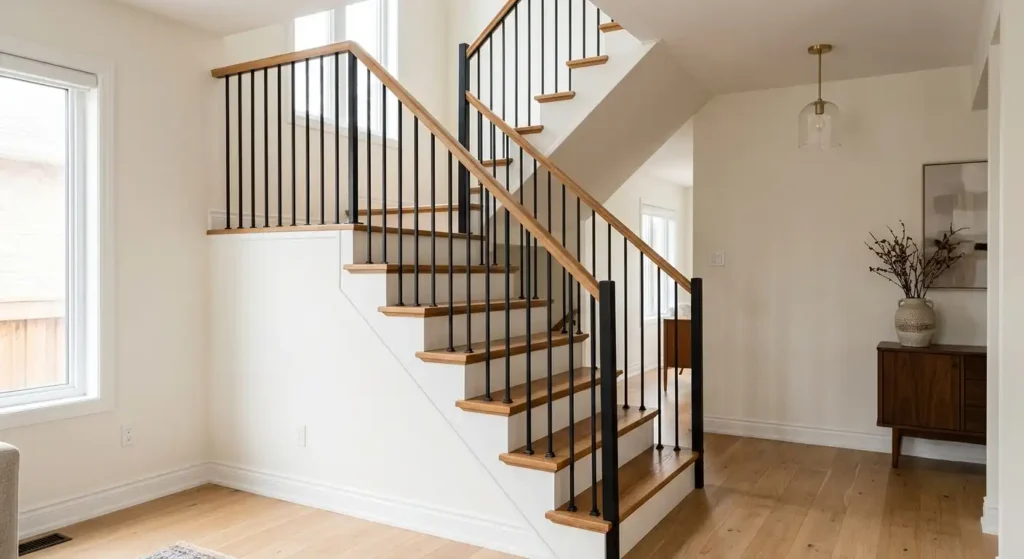
Iron sits in an unusual position among railing materials. It’s heavier and stronger than wood yet takes up far less visual space. It’s more transparent than a row of balusters yet has more character than a sheet of glass. For a great many Ottawa homeowners, that middle ground turns out to be exactly where they wanted to be.
Iron railings also happen to be one of the most cost-effective upgrades available to an existing staircase. Because the treads, the newel posts, and the handrail can all stay exactly where they are, swapping tired wooden spindles for slim iron balusters transforms a staircase without touching its structure.
Why Iron Works So Well on Stairs
Wooden balusters are thick because they have to be. Wood needs bulk to carry load, so a typical spindle runs thirty to forty millimetres across, and a full run of them creates a solid visual wall.
Iron doesn’t need that bulk. A twelve or sixteen millimetre bar is more than strong enough, which means you see through the railing rather than at it. Your staircase stops being a barrier in the room and starts being an object in it, and in a home where the stairs sit in the middle of an open main floor, that difference is substantial.
Iron is also close to indestructible. It won’t dent when a sofa goes upstairs, it won’t loosen the way wooden spindles do as they dry and shrink through an Ottawa winter, and a properly finished baluster holds its appearance for the life of the house.
Choosing a Baluster Style
The range is much wider than most people realise, and it splits cleanly between traditional and contemporary.
Scrolled and Twisted
Scroll patterns, curling forms worked into the length of the baluster, are the most decorative option available. Twisted balusters, where the bar is given a rope-like spiral through part of its length, are less ornate but still clearly traditional. Both suit century homes with ornate trim, plaster mouldings, and formal proportions.
The usual approach is to alternate: plain bars for most of the run with a decorative baluster every third or fourth position. A full run of scrolls becomes visually busy very quickly, and restraint reads as more expensive, not less.
Basket and Knuckle
A basket is a woven cage worked into the centre of the baluster, and a knuckle is a simpler collar or bulge at the midpoint. Both add interest without the full commitment of a scroll, and both work particularly well in transitional homes that want a nod to tradition rather than a full statement of it.
Plain Bars in Matte Black
This is the dominant contemporary look. Square or round bars, no ornament at all, finished in matte or satin black. It pairs exceptionally well with warm wood, and the reason it works is contrast: the black reads as a graphic line against a light wall and a warm tread, and your eye passes straight through the gaps.
Horizontal and Cable
Rather than vertical balusters, horizontal bars or tensioned cables run between the newels. The look is decidedly modern and it maximises the view. Be aware that horizontal members create a climbable ladder for small children, and code treats them carefully, so raise it with us early if your household includes toddlers.
Mixed Metal and Glass
Iron posts with glass infill panels combine the graphic strength of metal with total transparency. It’s the most expensive of the modern options and also the most striking, particularly on a landing where the railing is seen against a window.
Picking a Finish
Interior iron isn’t exposed to weather, which removes the main enemy, so the finish is really what you’re choosing.
Matte black powder coat is the default and the most forgiving, since it hides dust well and touches up easily. Satin black has a slight sheen and reads a little more refined. Oil-rubbed bronze suits traditional homes with warm hardware elsewhere, and brushed or satin nickel produces a lighter, more industrial feel that works in loft-style spaces.
Pairing Iron with Your Treads
Iron is almost never used alone. It’s a railing material, and the treads beneath it are still wood, so the pairing is the real design decision.
Matte black iron against warm oak stairs is the combination we install most often, and it’s hard to get wrong. The black grounds the warm tone of the wood and suits traditional, transitional, and modern homes equally.
Maple stairs with black iron read cooler and more contemporary. If your floors are white oak flooring, matching treads with black balusters produces the bright, modern look that dominates current Ottawa renovations. Where your main floor is engineered hardwood, matching solid treads in the same species keeps the transition seamless while the iron does the visual work.
The handrail is usually wood even in a mostly-iron railing, because a wooden handrail is simply nicer to grip than a metal one, particularly in winter.
Swapping Wooden Spindles for Iron
This is the upgrade worth knowing about, because it’s far less invasive than most homeowners assume.
The existing wooden balusters are cut out, the holes in the tread and handrail are prepared, and new iron balusters are set into place and epoxied. Treads, newels, handrail, and structure all stay put, and a typical straight run can often be done in a day or two.
The result is disproportionate to the effort. A staircase that read as heavy and dated becomes open and current, without any of the disruption of a full stair renovation. Code still applies, so baluster spacing has to be correct, and a flooring contractor who handles stair work will confirm the layout before cutting anything. Our pre-installation checklist covers how to prepare the space beforehand.
Almost No Maintenance at All
This is where iron quietly wins. Dust the balusters when you dust anything else, wipe the handrail periodically, and that’s essentially the whole programme.
Compare that with the hardwood floor care your treads require and iron is by some margin the lowest-maintenance element on the staircase. If a powder-coated finish does get chipped, touch-up paint matched to the coating handles it in minutes.
Twelve Millimetre or Sixteen? Come and Hold Both
The weight of an iron baluster in your hand tells you more than any photograph will. Matte black and satin black look identical on a screen and quite different in a hallway, and the visual gap between a twelve and a sixteen millimetre bar is far larger than the numbers suggest.
Visit our flooring showroom on Colonnade Road to compare profiles, finishes, and tread species side by side, browse our room scenes gallery for design inspiration, and review our our work portfolio for completed iron baluster projects.
Ready to get started? Reach out for the flooring services ottawa homeowners trust, or call 613-274-7977 to schedule your free consultation.
